← All projects01 / 02
Snip
- Role
- Design, development and deployment
- Year
- 2026
- Stack
- Next.js, Go, PostgreSQL, River, ffmpeg, Kubernetes
- Links
- Live site ↗
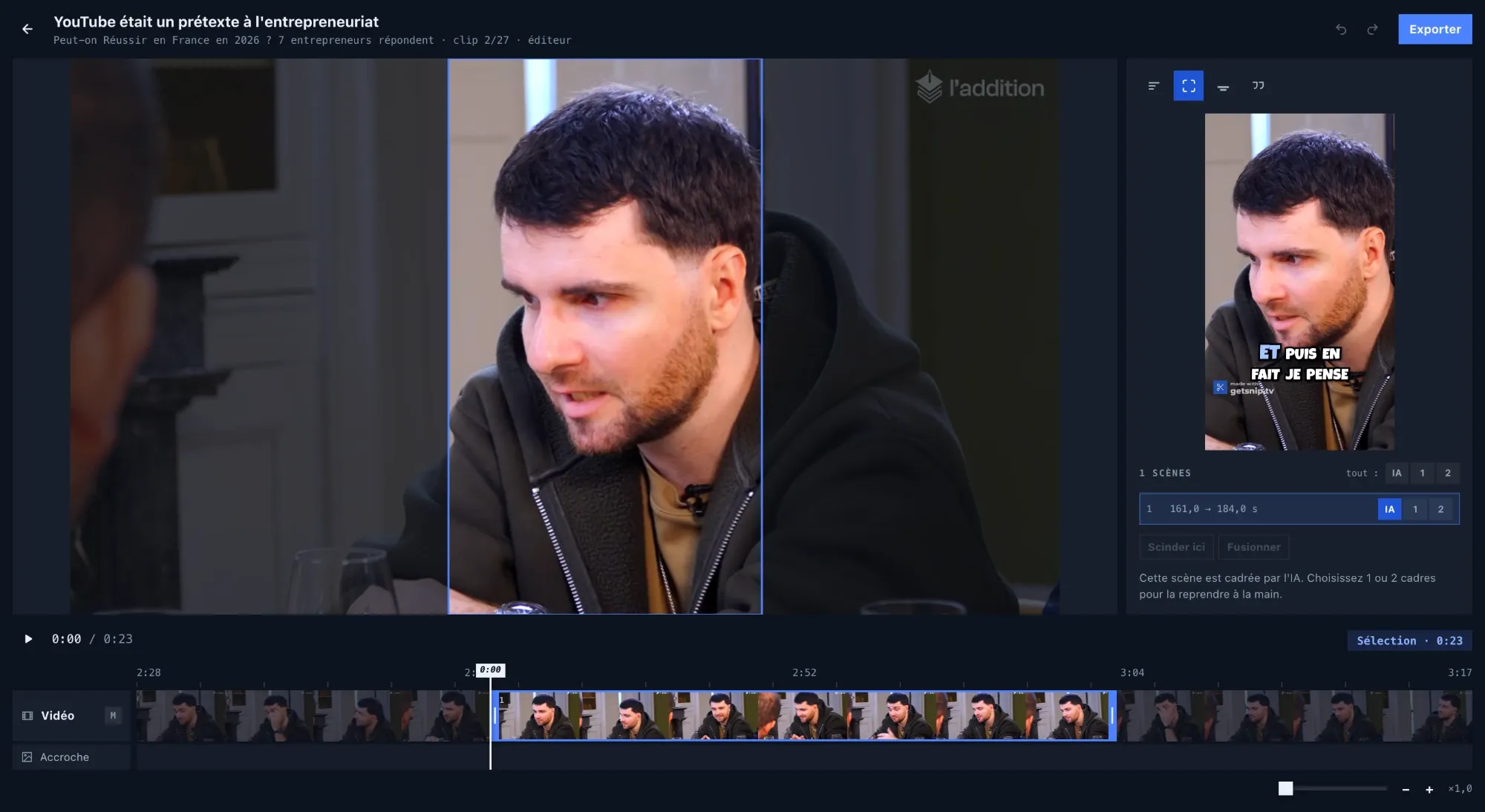
A long video, YouTube link or upload, becomes a set of captioned vertical clips, ready to post.
The product
Snip takes a long video and turns it into captioned 9:16 vertical clips, each with a hook title. The source is downloaded and transcribed, a language model picks the passages that stand on their own, and each passage becomes a clip: framing on the subject, cutting, burned-in captions. Users can then tweak a clip in the editor and render it again.
What I built
- The Next.js application (App Router, React 19): interface, authentication, Stripe subscriptions, clip editor, in French and English.
- A Go worker that runs the pipeline as a chain of River jobs stored in PostgreSQL: download, transcription, selection, clip building, finalisation. Every step can be replayed without recomputing anything, because no state lives in memory: everything goes through object storage.
- Automatic framing with ffmpeg and a Python sidecar (OpenCV face detection), and a single caption drawing code shared by the browser preview and the server-side export, so both stay identical.
- A queue that is fair across accounts, achieved by ordering jobs by a virtual finish tag instead of their arrival time, with the heavy work handed to Scaleway Serverless Jobs started on demand.
- Deployment on Kubernetes (Scaleway Kapsule) with kustomize, observability with Grafana and self-hosted Umami analytics.
Stack
TypeScript, Next.js, Go, PostgreSQL, River, ffmpeg, OpenCV, AssemblyAI for transcription, OpenRouter for passage selection, Stripe, Kubernetes.